
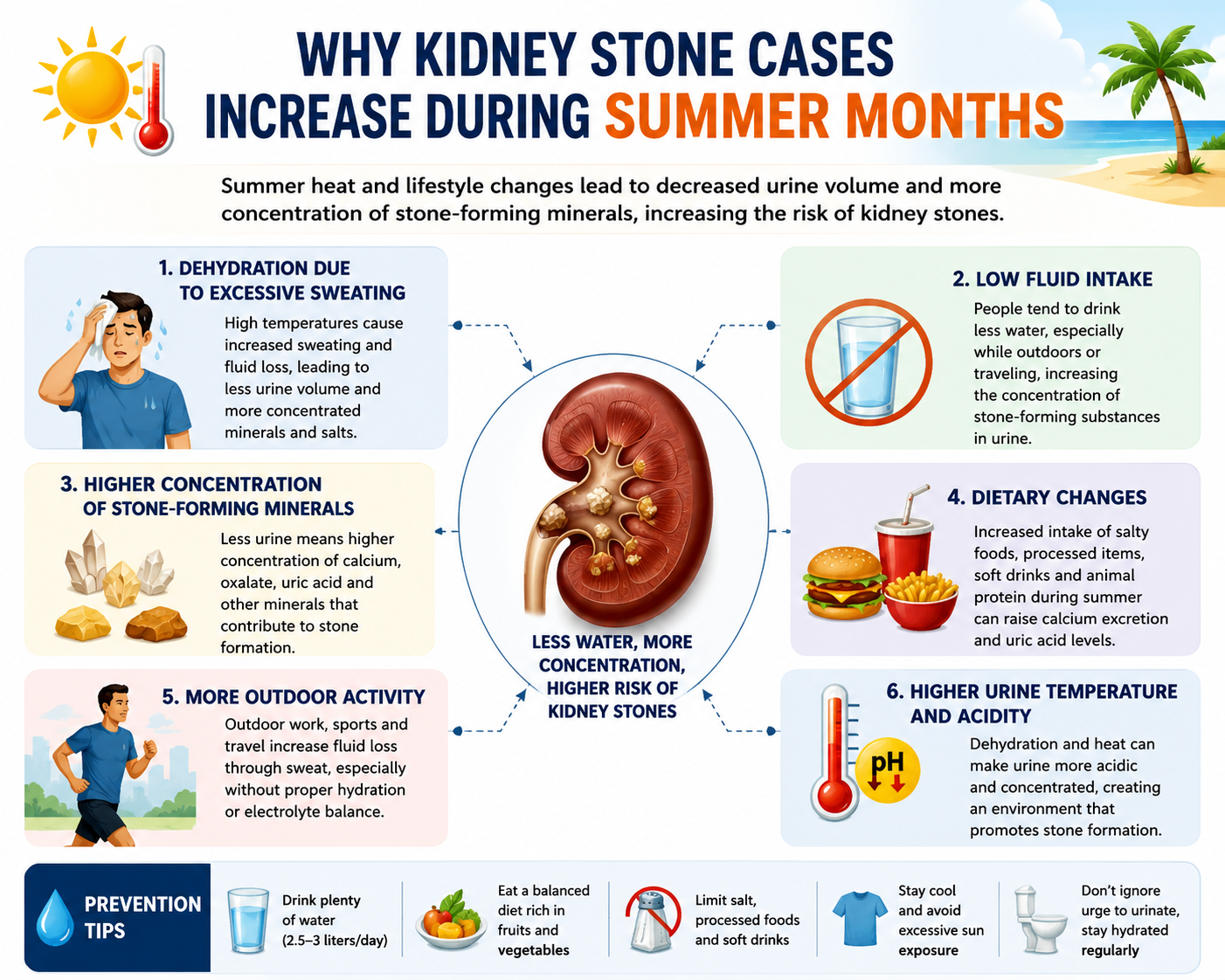
Why Kidney Stone Cases Increase During Summer Months
Kidney stones are a condition which is very commonly seen today, but the connection to summer is something most people are not aware of. Kidney stones in summer catch most people off guard. The back starts hurting and it does not go away. Urinating becomes uncomfortable. They assume it is something else entirely. All these signs are easily ignored and put down on other things. What feels like a minor issue might actually be a kidney stone that has been forming quietly without any warning.
Today, let us understand why kidney stone cases go up during summer so that every person can take the right steps before time and avoid any uncertain circumstances.
What Most People Do Not Know About Summer and Kidney Stones
It is one of those conditions that does not show a clear reason in the beginning. People carry on with regular work without any obvious difficulty. By the time anyone finds out, things have already gotten worse.
Knowing what summer does to the body can help before things get worse.
What Are Kidney Stones
Kidney stones form when minerals and salts are collected in the urine and harden over time. In the beginning, there are usually no clear signs at all. People usually do not notice this at first but if it continues for a longer period of time then it can lead to bigger issues that are harder to manage.
Kidney stones are not all the same size. Some are small enough to pass on their own. Others are bigger and the pain they cause needs a doctor. Most people miss the early signs because nothing feels serious at first. If left alone, it tends to get worse.
What Happens Inside the Body During Summer
The body loses significantly more water during summer through sweat. When this water is not replaced properly, the urine becomes more concentrated than it should be. Minerals and salts that should be flushed out begin to settle in the kidneys instead. People usually do not notice this at first but if dehydration continues for a longer period of time, then it can lead to kidney stones forming gradually.
This is the most seen reason behind the increase in kidney stone cases during summer. It is one of those things that build quietly and only becomes noticeable when the pain begins. People usually put the pain down to other reasons without connecting it to dehydration, but if water intake is not increased during summer, then the risk of kidney stones increases significantly.
Reasons Behind the Increase
Dehydration alone is not always the only reason. There are certain other factors that also contribute to kidney stone formation during summer. Some of these are listed below.
Diet changes during summer play a role. More processed foods, salty snacks and protein rich foods. People usually consume these without thinking about the impact on kidney health, but if these habits continue for a longer period of time, then they can increase the risk significantly.
Vitamin D levels go up during summer, and most people do not connect this to kidney stones. When vitamin D increases calcium absorption and calcium levels in the urine remain high for a longer period of time, then it can increase the risk of kidney stones.
Physical activity also goes down during peak summer heat. People usually do not connect this to kidney health, but if physical activity remains low for a longer period of time, then it can increase the risk of kidney stones forming.
Signs That Should Not Be Ignored
To avoid unnecessary situations, the signs of kidney stones should be detected earlier. The early signs might seem very common but are to be kept in check if they continue for a longer period of time.
Back or lower abdominal pain that keeps coming back without any clear reason.
Burning or discomfort felt when passing urine.
Urine that appears darker, pink or red in color without any obvious reason.
Needing to pass urine more often than normal.
Nausea alongside back or abdominal pain.
Fever or chill alongside any of the above signs.
Signs are not noticed at first but if they continue for a longer period of time then it indicates that there is a problem. If any of these signs show up and there is no clear reason for it, get it checked early.
What Helps Reduce the Risk
Acting early makes a big difference. Some steps that help are listed below.
Drinking enough water throughout the day is the most important thing. Most people think there are a few glasses here and there are enough. But the body needs significantly more during summer, and if this is not maintained consistently, then the risk of kidney stones goes up. It is advised to drink at least eight to ten glasses every day during summer months.
Staying physically active even during summer is also important. People usually reduce activity during summer without thinking about the impact on kidney health, but if regular movement is maintained for a longer period of time, then it can help reduce the risk of kidney stone formation significantly.
Limiting oxalate rich foods is also one of the steps. People usually ignore this but if oxalate intake is kept in check consistently for a longer period of time, then it can make a significant difference to kidney health and reduce the risk of stone formation.
Getting regular health checkups done is also advised. People usually put this off without connecting it to kidney health at all. But if checkups are done regularly, then problems can be caught and managed before they develop further.
Eating well and getting enough calcium from natural foods also helps. Most people cut out calcium thinking it makes things worse. But low calcium in the diet can actually increase the risk. It is always better to consult a doctor about the right dietary balance rather than making changes on the basis of assumptions.
When to Consult a Doctor
Early signs of kidney stones are easy to ignore, and most people do. It is better to consult a doctor if any of the following situations apply.
If severe back or abdominal pain continues without any clear reason.
If there is blood in the urine or urine appears discolored.
If there is a burning sensation when passing urine, that continues without improvement.
If nausea or fever is happening alongside back or abdominal pain.
Consult a doctor at the earliest even if everything else still seems manageable.
Conclusion
Kidney stones are a condition which is very commonly seen today, and the cases increase significantly during summer months. This can happen to anyone at any time even if everything seems normal from the outside. The best way to avoid such things happening is quite simple.
Drinking enough water, eating right and seeing a doctor on time goes a long way. The kidneys are just as important as any other part of the body. But most people only do something about it once the pain sets in. Catching it early makes things a lot easier to manage.
FAQs
1. Why do kidney stone cases increase during summer?
Dehydration. The body loses more water through sweat during summer and when it is not replaced properly then minerals start settling in the kidneys. People usually put this down for other reasons without connecting it to the season at all.
2. How much water should be consumed during summer?
More than most people think. The body needs significantly more water during summer than other months. People usually assume their regular intake is enough, but if proper hydration is not maintained, then the risk goes up.
3. Can diet affect the risk of kidney stones?
Yes. High salt intake, oxalate rich foods, and too much protein. People usually follow these habits without connecting them to kidney health at all. But if dietary changes are made consistently, then the risk can be reduced significantly.
4. Are kidney stones in serious condition?
Not always. Small stones pass on their own. But if the pain is severe or blood appears in the urine, then it should not be ignored. It is advised to consult a doctor quickly.
5. How are kidney stones diagnosed?
A doctor will usually check medical history and recommend blood tests and ultrasound. People usually rely on self-diagnosis but it is always better to consult a doctor for a proper diagnosis.