
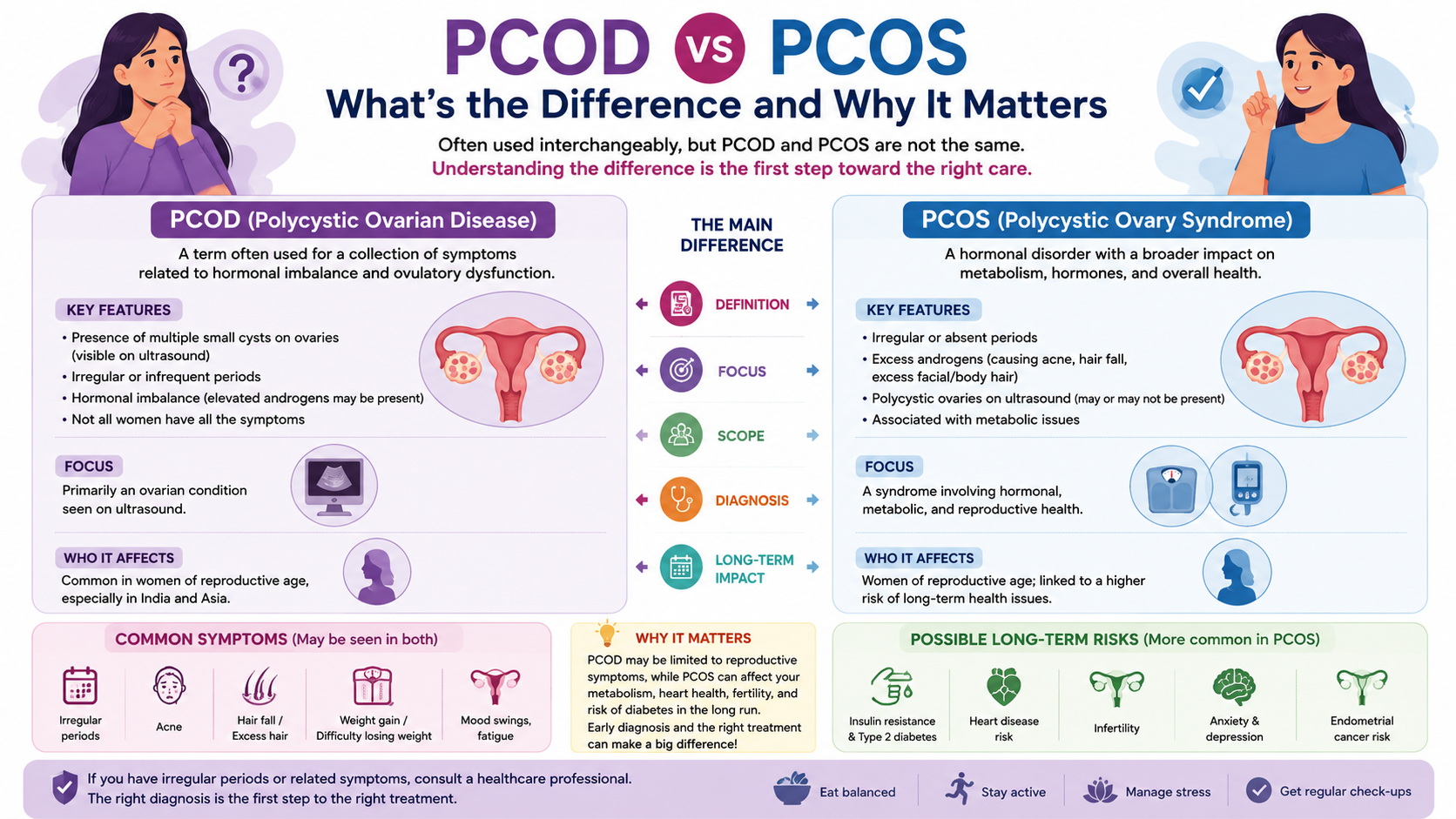
PCOD vs PCOS: What's the Difference and Why It Matters
PCOD and PCOS are conditions which are very commonly seen today but are very rarely understood correctly. Most women who get diagnosed with either one is not sure what sets the two apart. People usually go on assuming both conditions are the same thing, but that assumption leads to the wrong approach being taken for a longer period of time.
Knowing the difference is not just useful information. It is what helps a woman get the right treatment at the right time.
Why Most Women Get Confused Between the Two
The confusion exists because the symptoms of both conditions overlap significantly. Irregular periods, weight gain that is hard to explain, persistent acne, changes in hair. All of these show up in both PCOD and PCOS and so most women who experience these symptoms do not know which condition they are dealing with.
People usually go on without a clear diagnosis for a longer period and by the time they get one, the condition has already been developing without the right management. A clear understanding of each condition helps in getting the right answer sooner.
PCOD - What It Is and What It Means
The full form is Polycystic Ovarian Disease. The ovaries stop releasing mature eggs the way they should. People usually do not notice this at first but if it continues for a longer period then irregular periods, hormonal imbalance and other symptoms start showing up and should not be ignored.
PCOD is generally considered less severe than PCOS. People usually underestimate how much of a difference the right diet, regular physical activity and stress management can make, but if these are followed consistently for a longer period of time then the improvement in the condition is significant.
Women with PCOD can in most cases conceive naturally if the condition is being managed properly. Lifestyle plays a very direct role in how well PCOD is controlled, and this is what makes it more manageable than PCOS.
PCOS - What It Is and What It Means
PCOS stands for Polycystic Ovary Syndrome. It is a more complex condition than PCOD. People usually assume it only affects the ovaries but if it continues for a longer period then it affects the hormonal and metabolic systems of the body as well. People usually treat it as the same thing as PCOD, but the two conditions are different in important ways that affect how they need to be handled.
One of the key features of PCOS is elevated androgen levels. Androgens are male hormones and when their levels go up in a woman's body, the symptoms that follow are more visible and harder to manage. Excess hair on the face or body, noticeable hair loss from the scalp, acne that does not respond to regular treatment.
PCOS is also linked to insulin resistance. People usually ignore this but if it continues for a longer period of time then it can increase the risk of type 2 diabetes and should not be left unaddressed.
The Key Differences Between PCOD and PCOS
People usually assume both are the same thing, but if the differences are understood then it becomes easier to get the right treatment on time.
What Causes Them
PCOD is largely caused by lifestyle-related factors. Poor diet, lack of physical activity, weight gain, and ongoing stress are some of the most seen contributing factors. PCOS has a stronger genetic and hormonal basis and cannot be period lifestyle changes alone. This is also what makes PCOS harder to control over a longer period of time.
How Serious They Are
PCOD can in most cases, be managed without long term medication. PCOS, on the other hand is a more serious condition that needs ongoing medical attention. People usually do not realize how different the two are in terms of severity until a proper diagnosis is done by a doctor.
Effect on Fertility
Women with PCOD are in most cases able to conceive naturally once the condition is being managed properly. PCOS has a more significant impact on fertility due to the degree of hormonal imbalance involved and may require medical intervention in some cases. It is advised to consult a doctor early if pregnancy is being planned and either condition has already been diagnosed.
Hormonal Differences
Both conditions involve hormonal imbalance, but PCOS involves significantly higher androgen levels. People usually do not realize this difference, but it is one of the most important things to understand when comparing the two conditions. PCOD involves a milder hormonal disruption that responds better to lifestyle and dietary changes. PCOS causes more severe and visible symptoms because of the higher androgen levels involved.
Why the Difference Actually Matters?
Knowing whether it is PCOD or PCOS is not just a matter of having the right name for the condition. It directly affects what treatment is needed and how the condition should be managed. People usually assume both conditions can be handled the same way, but if PCOS is being managed like PCOD then the treatment will not be enough and symptoms will continue for a longer period without real improvement.
Getting the correct diagnosis early is what ensures the right steps are being taken from the beginning rather than spending months on an approach that is not suited to the actual condition.
Managing PCOD
PCOD can, in most cases, be managed with lifestyle changes. A balanced diet, regular physical activity, and proper stress and sleep management are some of the ways that help. People usually underestimate the impact that consistent lifestyle changes can have on PCOD, but if they are followed for a longer period, then the improvement in the condition is significant.
A doctor may, in some cases, also recommend medication to regulate periods or manage specific symptoms. People usually start medication on their own without consulting a doctor, but it is always better to consult a doctor before starting any treatment.
Managing PCOS
PCOS can only be managed with a combination of lifestyle changes and medication. People usually try to handle it on their own, but if it is not given proper medical attention for a longer period of time, then it can lead to bigger issues that are harder to manage. It is advised to consult a doctor early.
Medication for PCOS can include hormonal treatment to regulate periods, medication to manage insulin resistance and anti-androgen medication for symptoms like excess hair growth and acne. People usually ignore this but if it continues for a longer period of time without proper treatment then it can lead to complications. It is advised to consult a doctor rather than wait for things to get worse on their own.
To Sum It Up
PCOD and PCOS are conditions which are very commonly seen today and affect many women. This can happen to anyone at any time even if everything seems normal from the outside. The best way to avoid such things happening is quite simple.
Getting the right diagnosis on time and following the correct management plan is what makes the real difference. It is possible to handle the conditions before time.
FAQs
1. What is the main difference between PCOD and PCOS?
PCOD is less severe. Mainly caused by lifestyle factors. PCOS is more complex and affects multiple systems of the body. Managing both the same way is where the problem starts.
2. Can PCOD turn into PCOS?
They are in two different conditions. PCOD does not turn into PCOS. But if it is not managed properly for a longer period of time then complications can develop.
3. Can women with PCOD or PCOS get pregnant?
Yes. Women with PCOD can usually conceive naturally if the condition is managed. PCOS is different. Medical support may be needed in some cases. It is advised to consult a doctor early if a pregnancy is planned.
4. Is PCOD or PCOS a permanent condition?
Not always, PCOD can improve with consistent lifestyle changes. PCOS needs longer term management. But its symptoms can be controlled with the right medical guidance.
5. How is PCOD or PCOS diagnosed?
A doctor will check medical history and recommend blood tests. An ultrasound to examine the ovaries is also commonly done. People usually rely on self-diagnosis. It is always better to consult a doctor.