
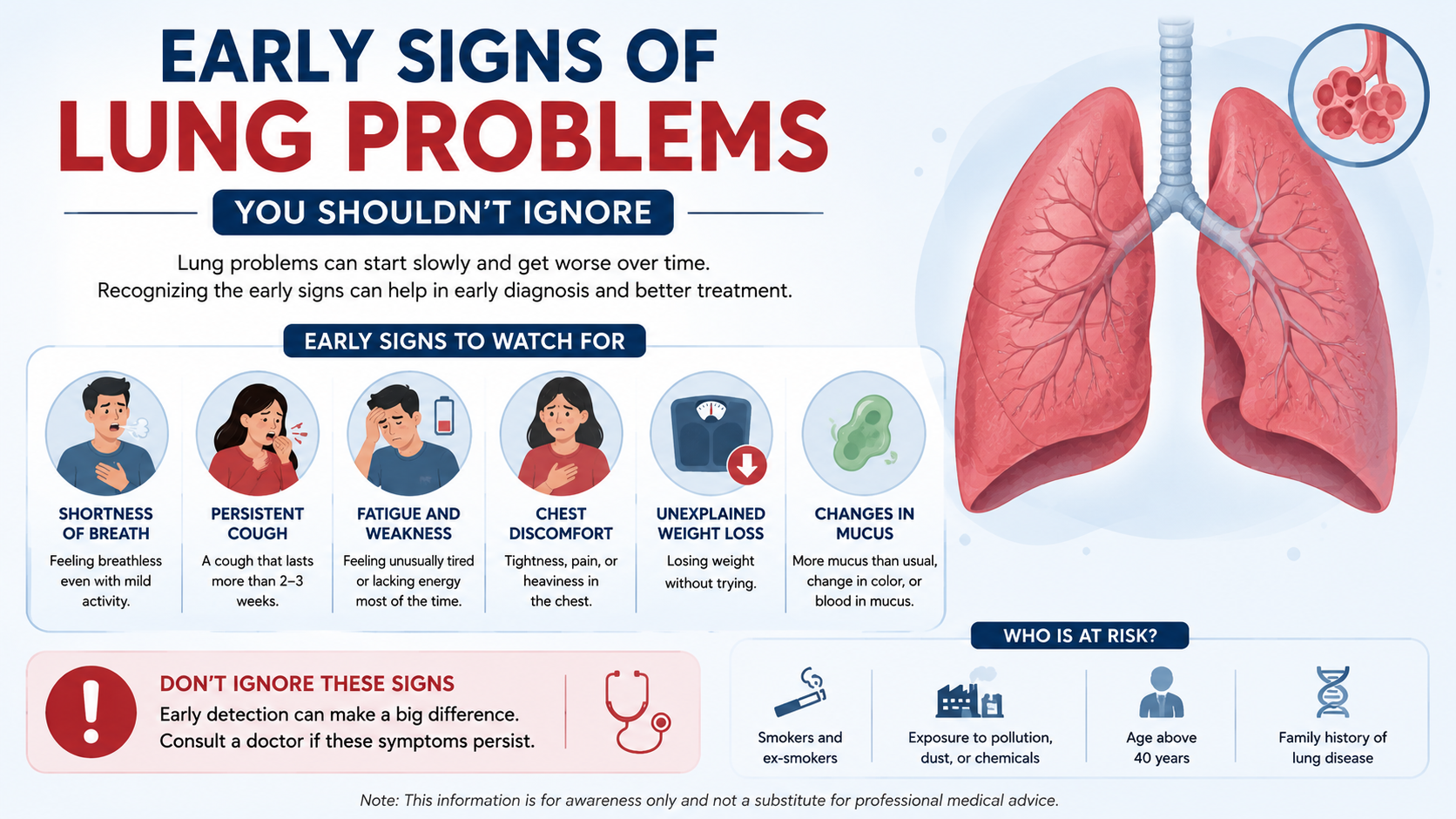
Early Signs of Lung Problems You Shouldn't Ignore
People give very little thought to their lungs until something goes wrong. And by the time something feels wrong enough to act on, it has usually already been building for quite a while. The tricky part about lung problems is that the early signs do not look like lung problems. They look like a cough from the weather, tiredness from a long week, a bit of heaviness in the chest from stress. Easy to explain away, and so they get explained away.
But these small signs matter. And knowing what to look for can make a real difference to how things turn out.
Why People Miss the Early Signs
The early stage of most lung conditions does not slow a person down. Work continues; routines stay the same, and nothing feels serious enough to see a doctor about. This is exactly why lung problems tend to get picked up late. Not because the signs were not there, but because nothing about them demanded immediate attention.
A sign that feels minor is still a sign. Especially when it keeps coming back.
1. A Cough That Has Stayed Too Long
A cough that clears within two weeks is normal. A cough that is still sitting around after three weeks without any clear reason is not. People usually blame dust, dry air or a cold that passed weeks ago, but if it continues for a longer period of time then it can indicate that the lungs are signaling something. If blood or heavily discolored mucus is coming up with the cough, then a doctor should be seen immediately without waiting.
2. Breathing That Has Become Harder Work
Breathlessness during exercise is one thing. Breathlessness while doing simple daily tasks like walking or going up to one floor is a different matter. People usually do not realize this because the change happens so slowly that it starts feeling normal. Some activities start getting avoided without any clear reason being connected to it. But if breathing during ordinary daily tasks has been feeling harder than before for a while, then it should not be left unattended.
3. A Whistling Sound When Breathing
A whistling or squeaky sound when breathing without any known cause is something that should not be left unattended. People with asthma or allergies usually already have a trigger they are aware of. But if it is showing up without any such history or is becoming more frequent than before, then a doctor should be consulted. People usually ignore this thinking as it is minor, but if it is happening regularly then it is better to get it checked.
4. Chest That Feels Heavy or Tight
Chest heaviness is something people usually connect to the heart. But the lungs are also capable of causing this feeling. If it is showing up when breathing in deeply, or is coming alongside a cough that has been there for a while, then it should not be ignored. People usually wait to see if it settles, but if it continues for a longer period of time then it is better to consult a doctor.
5. Fatigue That Rest Does Not Fix
This is a specific kind of tiredness. Not the kind that comes from a long day or a bad night of sleep. The kind that is sitting there from the moment a person wakes up and does not shift no matter how much rest they get. When the lungs are not delivering oxygen properly, the body runs below what it needs, and everything feels harder as a result. Weeks of this without any clear explanation is reason enough to get the lungs checked.
6. Chest Infections That Keep Returning
A chest infection once in a while is not unusual. But if it is coming back repeatedly throughout the year or is taking longer to clear than it used to, then this is also one of the signs. People usually take medicine for each infection and carry on without giving it much thought. But if the same problem keeps coming back then it indicates something is not right with the lungs and it should not be ignored.
7. Blood When Coughing
This is one sign that should never be set aside, no matter how small the amount is. Blood appearing when coughing does not always point to something severe, but it always needs to be examined by a doctor without delay. There is no version of this sign that is safe to ignore or wait on.
People Who Should Pay Closer Attention
People who smoke or have smoked in the past carry a higher risk as the damage from smoking builds over many years before any symptoms become visible. People who have spent long periods working around heavy dust, asbestos, or chemical fumes are also in this group. Signs are not noticed at first in these cases but if they continue for a longer period then it indicates that there is a problem and a doctor should be consulted without delay.
When to See a Doctor
If any of the signs above have been present for more than a few weeks without improvement, a doctor should be seen. Not when it gets worse, not after trying a few more home remedies.
A cough that has not cleared in over three weeks. Breathlessness that is gradually getting worse. Chest tightness or wheezing without a known cause. Any blood when coughing. These are not things to manage at home and hope for the best.
Why Acting Early Makes a Difference
Lung conditions found early are in a completely different category from those found late. Some can be treated effectively. Others can slow down significantly. But both of those outcomes depend on the condition being caught before it has had time to develop further. The gap between an early finding and a late one is almost always just a matter of how long a person waited before getting checked.
To Sum It Up
Lung problems are more common than most people expect, and the early signs are something that almost everyone ignores at some point. A cough, some tiredness, breathing that feels slightly off. None of them feel important enough to do something about it.
But these signs are the body giving an early warning, and acting on them at the right time is what prevents the situation from reaching a stage that is much harder to deal with. Lung health deserves the same attention that is given to any other part of the body. The earlier a problem is caught, the better the outcome will be.
FAQs
1. How long should a cough last before seeing a doctor?
A cough from a cold clear within two weeks. If it is still going after three weeks without improvement, it should not be ignored. People usually put it off thinking it will go, but if it continues then a doctor should be consulted.
2. Can people who have never smoked develop lung problems?
Yes. Dust, fumes, poor air quality at work, family history, all of these play a role. Lung problems are not limited to smokers only and assuming otherwise is where people go wrong.
3. Is getting breathless on the stairs always a sign of something serious?
Not always, but breathlessness during simple activities that did not use to cause it especially if it has been gradually getting worse is worth getting looked at. The body adapts quietly to worsening breathlessness, and that is exactly how this sign gets missed for so long.
4. What happens if a lung problem is found early?
Early detection opens more options. Some conditions respond well to treatment at an early stage. Others can be managed and slowed down significantly. Either way, finding it early is always a better position to be in than finding it after it has already progressed.
5. What does a doctor check when lung problems are suspected?
A chest X-ray is usually the starting point. Breathing tests that measure how efficiently air moves in and out of the lungs are also commonly used. Further tests may follow depending on what those show. The process is generally not complicated and does not take long.